How the install works
Your patients already do the home program. Here’s how it gets paid for.
Medicare and covered commercial plans pay a clinic to monitor it, every month, per patient. Capturing that is a job. This is the job, and who does which part of it.

The 40-Patient RTM Install
Done for you means we run the program. Your people keep the clinical work, and the money it earns.
A 90-day install for one flat fee, set in advance. No monthly fee while we install. Here is who does what.
Go live
Days 1–5Movra does
Dashboard configured, care plans loaded, your biller walked through the packet, enrollment scripts and QR cards ready for the front desk.
Your clinic does
Sign the paperwork and name one champion. That is the whole ask.
Enroll 40+ patients
Days 1–30Movra does
We run enrollment from your caseload: who is eligible, who gets asked, consent captured, the app on the phone before they leave.
Your clinic does
Your PTs prescribe the home program they were already going to prescribe.
Keep them transmitting
Every dayMovra does
Vexa, our AI coach, runs the home program with each patient and logs every session as a data transmission. We watch the day counts and nudge whoever is slipping before the month closes.
Your clinic does
Nothing. This is the part nobody on your payroll had time for.
The billing packet lands
By the 5thMovra does
Codes, data days, consent, setup evidence, organized claim by claim, on your biller’s desk by the 5th of every month.
Your clinic does
Your biller submits under your NPI like any other claim. Your clinicians log their own review time if they choose to bill the management codes, and keep every dollar of it.
Your clinic bills under its own NPI. Movra packages the documentation your biller submits. Movra does not bill on your behalf, and our fee is never a percentage of what you collect.
The packet
What lands on your biller’s desk by the 5th
One patient’s packet from a month’s set, with a made-up clinic and patient. On the call you walk it with your biller, field by field.
sample-packet.pdf · 4 pages
Open the PDF →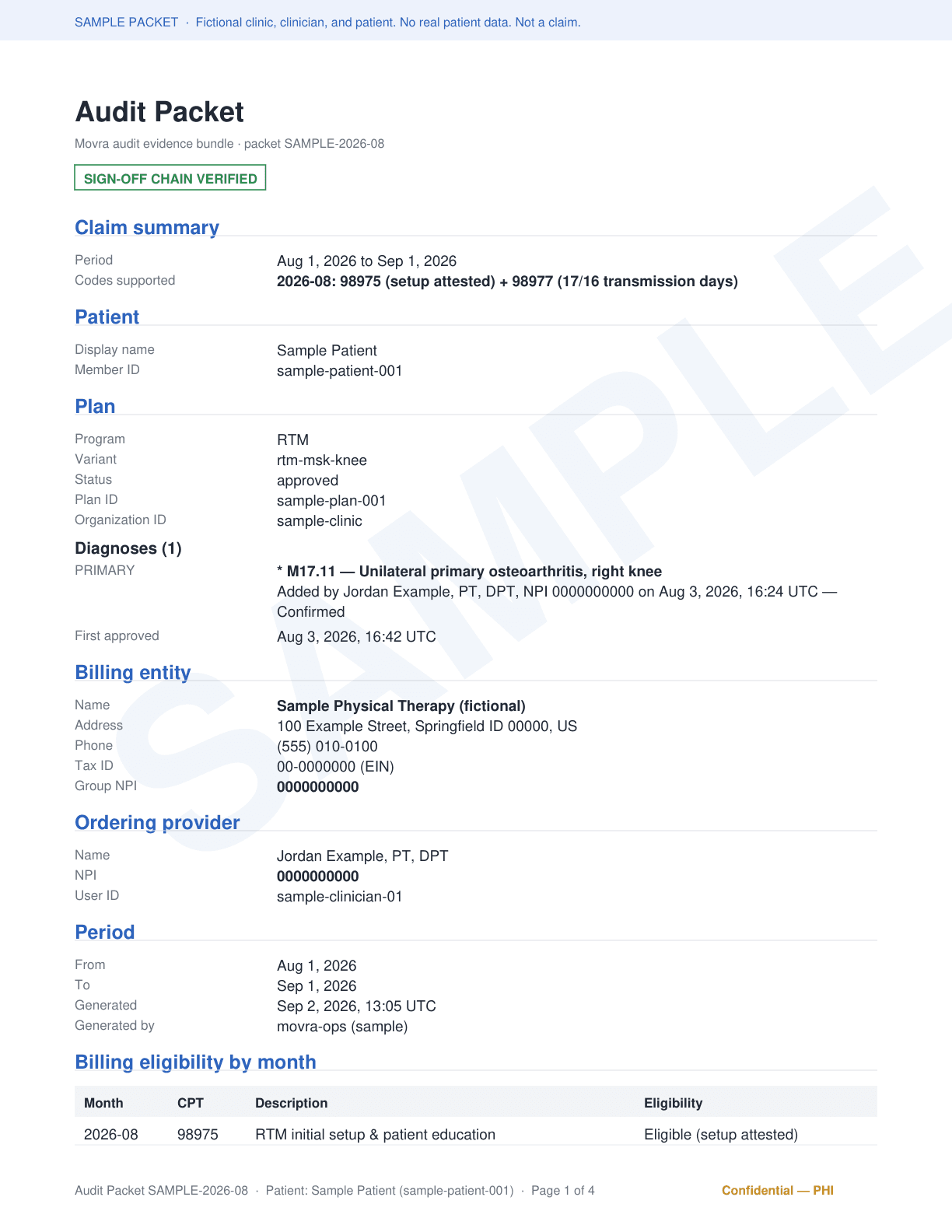
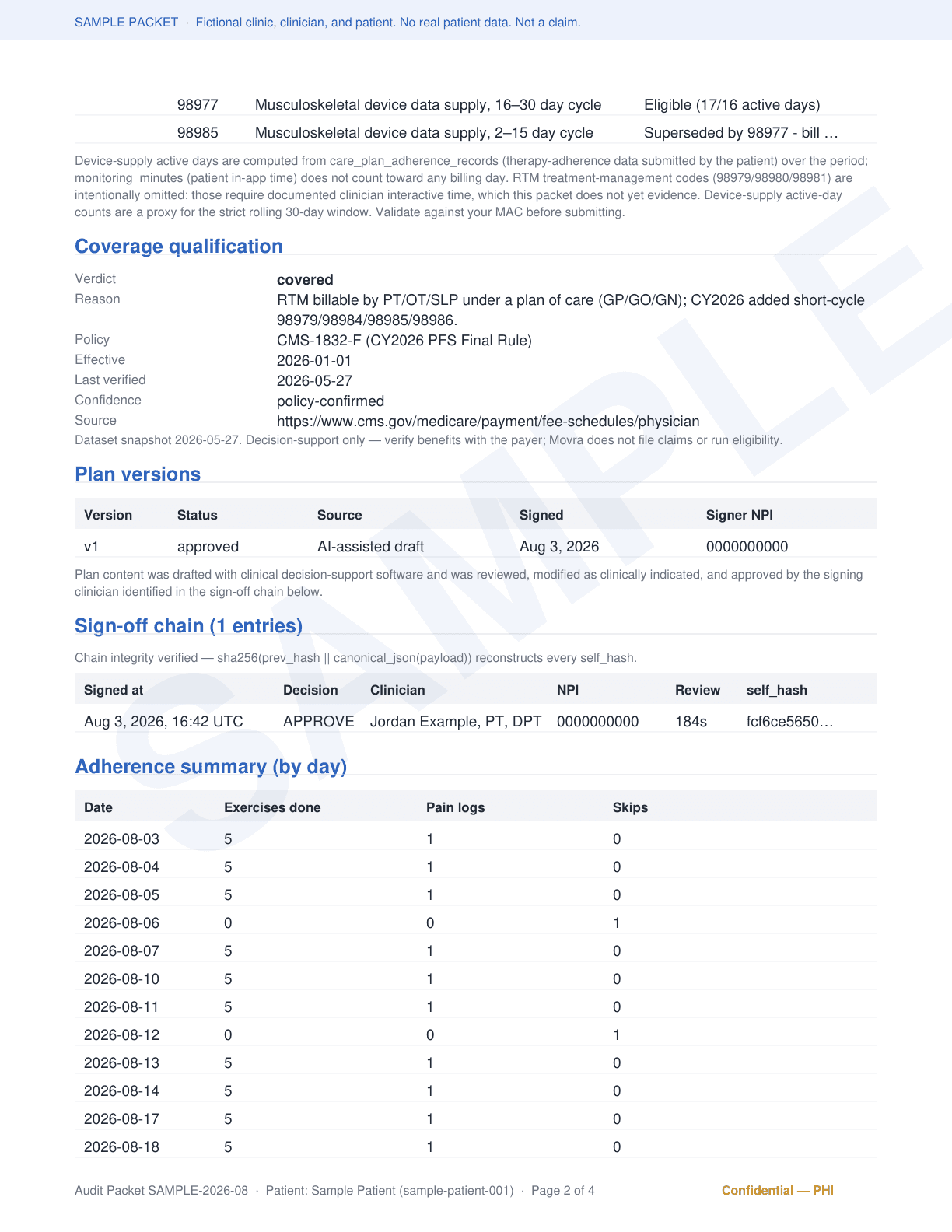
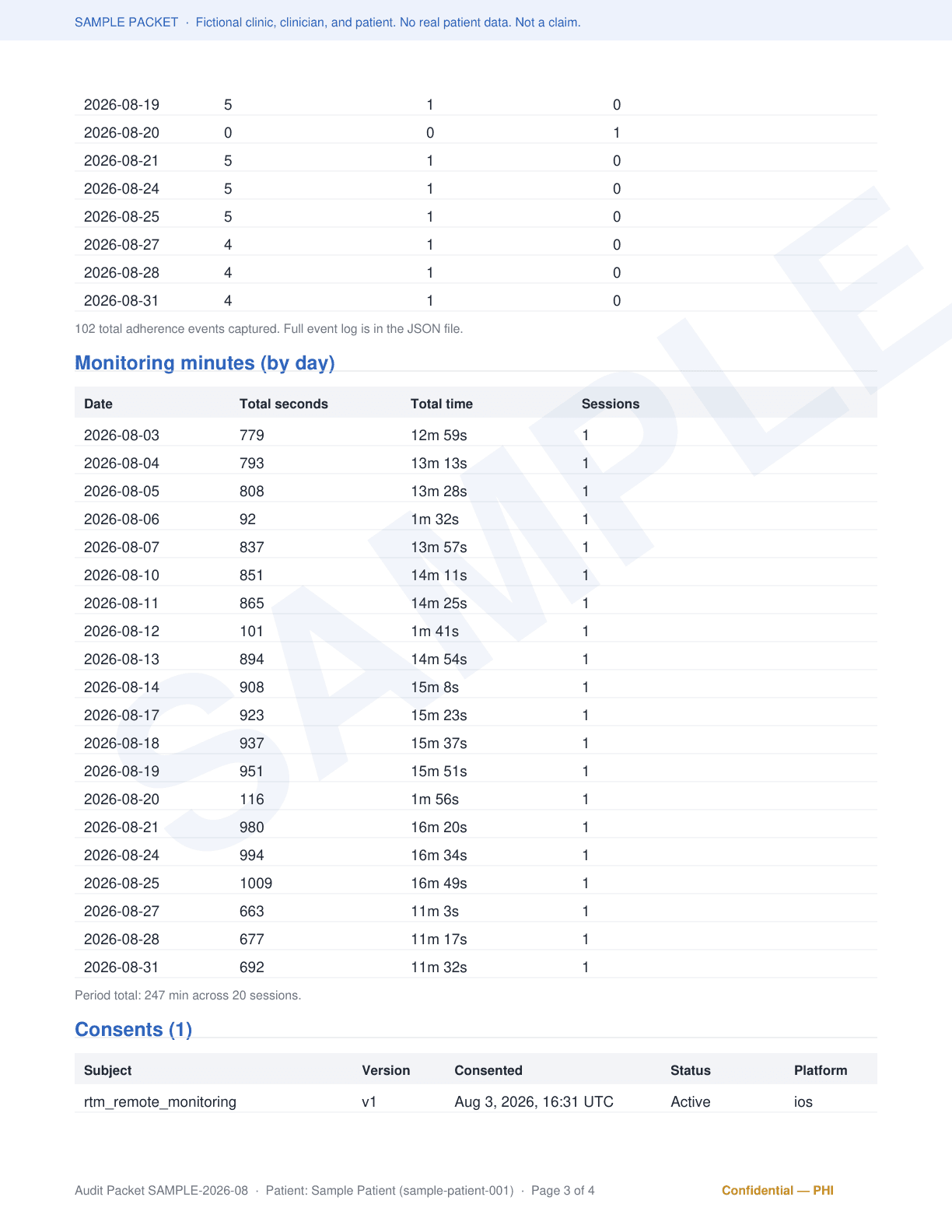
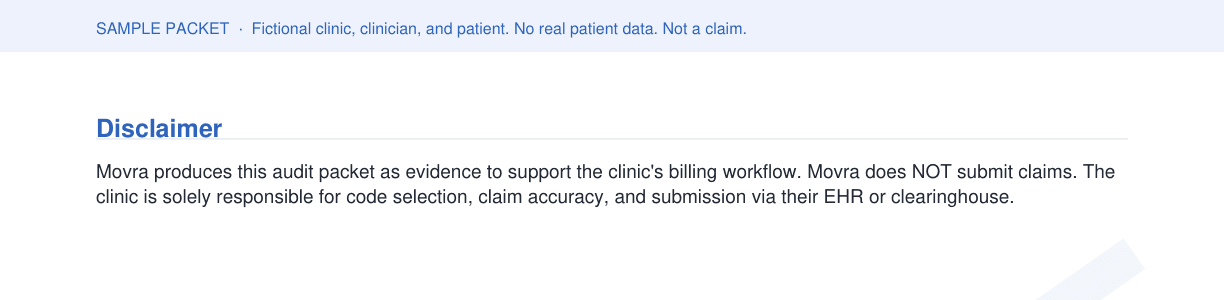
Sample. Fictional clinic, clinician, and patient; no real patient data. Rendered by the same code that builds your clinic’s packets.
The packet documents
- ✓Per-patient device-supply eligibility with the exact data days counted for the month
- ✓Setup and patient-education evidence for the one-time 98975 code
- ✓Consent captured at enrollment, timestamped
- ✓Session-level transmission log: what the patient did, when
- ✓The code each patient qualifies for this month, 98977 or 98985, never both
The packet does not
- ✕Your clinicians’ interactive treatment-management time. That evidence lives in your medical record, and only your clinic can attest to it.
- ✕Claim submission. Your biller submits under your NPI. We never touch a claim.
The second list is the point, not a limitation. Medicare’s proposed CY2027 rule would require monitoring by the billing practice’s own employees. Movra runs the program; your people do the clinical minutes and keep what those minutes earn. Every code, with its 2026 rate →
Questions
What clinic owners ask before they sign.
What happens if my clinic gets audited?+
Every claim your biller submits is backed by the packet Movra builds as the care happens: session-level monitoring transmissions, day counts, consent, setup evidence, organized claim by claim. You see the exact packet, blank, on the call before anything is signed. Your clinicians’ own review time, if they bill the management codes, is documented in your medical record, not ours.
Will my older Medicare patients actually use it?+
If a patient can take a video call, they can train with Vexa. We run enrollment in your clinic, the app goes on the phone before they leave, and we watch the day counts so the ones who are slipping get a nudge before the month closes. Keeping them transmitting is our job, not your front desk’s.
How much of my staff’s time does this take?+
During the install, a named champion and a few minutes of front-desk time while we enroll. After that, none for the program itself; that is what done-for-you means. Your PTs choose whether to spend 20 minutes a month per patient on the clinical review that bills 98980. That time is theirs, and so is the money.
Does my biller need to learn new software?+
No. By the 5th of every month Movra hands your biller a claims-ready packet: codes, day counts, documentation. They submit under your clinic’s NPI like any other claim. Nothing new to install or learn.
Which codes does this actually document?+
The monitoring codes: 98975 (setup, $21.71 once per patient) and 98977 or 98985 (device supply, $51.44 a month, depending on data days). The treatment-management codes, 98979, 98980 and 98981, are billed on your own clinicians’ logged time and your own records.
Full 2026 code reference, built to forward to your biller →What does Movra cost?+
A flat fee, set in advance, never a percentage of what you collect. The number depends on what the caseload audit shows, which is why we run the audit first and walk the price on the call, with your numbers on the table.
Is this HIPAA compliant?+
Movra operates as your Business Associate. Your clinic stays the Covered Entity; we handle PHI under a Business Associate Agreement, on infrastructure encrypted in transit and at rest, with role-based access and audit logging on PHI access. And the flat pricing is deliberate: our fees are never contingent on what your clinic collects.
What about patients with commercial insurance?+
Often, yes. Medicare Advantage plans generally have to cover what traditional Medicare covers, though a plan can require prior authorization. Anthem, Blue Cross NC, Highmark, BCBS Michigan and Minnesota, and several state Medicaid programs publish RTM coverage, and UnitedHealthcare lists the codes as eligible for reimbursement. Cigna and Regence exclude it. Aetna and most other commercial plans have not published a position, which means a call to the payer, not a guess. The audit checks the payers you name against their published policy and tells you which is which.
Open the payer coverage checker →Do I need EMR integration?+
No. Movra runs alongside your EMR and never touches your existing systems. Your biller enters the claims from the packet like any other claim.
What if you miss a milestone?+
We keep working at no charge until it is met. A missed go-live or enrollment target extends the install on our dime. A late packet after conversion waives that month’s fee. Money never moves backward; we just don’t stop.
The three promises →Free caseload audit
Your payers, your timeline, your number. In writing.
Your active patients, your payer mix, your state. Back comes the Medicare floor with its basis, each payer checked against published RTM policy, what has gone unbilled since January, a twelve-month ramp, and a straight answer on whether you clear the 40-patient bar.
Get your free caseload auditAbout two minutes. No call required to get your sheet.
Founder-run, 4 to 6 new locations a month. The audit decides who gets one. The 5-40-5 Guarantee on every install.