For private PT practices · 3 to 8 clinicians · Medicare or covered commercial in the mix
Every home program you prescribe is unpaid work.
Medicare, and a growing list of commercial plans, pay a clinic to monitor the exercises its patients already do at home, every month, per patient. Almost nobody collects it, because collecting it is a job nobody in the building has time for, so we run that job for you.
Founder-run, 4 to 6 new locations a month · Flat fee, never a percentage · The 5-40-5 Guarantee
Count your floor
Your payer mix
Cash and other: 20%
Medicare patients, billable-eligible now
per month from Medicare alone, at $51.44 each. Covered commercial plans add to it.
To verify · commercial and Medicaid
Patients on these plans, each plan checked against its published policy in the full audit.
Clears the 40-patient bar we guarantee to enroll in 30 days.
Get my full audit →- ·Your commercial payers, checked
- ·Unbilled since January
- ·Twelve-month ramp
- ·The sheet, in writing
Device-supply code only, 2026 Medicare national rate. Assumes 80% go home with a program. Billed is not collected.
We start 4 to 6 locations a month. The audit decides who gets one.

The problem, exactly
Your patients already do the work. Nobody in your clinic gets paid for it.

80 seconds · presented by Austin’s AI clone
Four things every owner says on the first call, and what is actually true.
Not worth it
“It’s a few dollars a patient. Not worth the hassle.”
~$51
per patient, per month, for the home program they already do.
Device supply alone pays $51.44 a month per enrolled patient, and it never pays retroactively. Your schedule is full and you cannot add headcount. The only unworked asset in the building is the patients already on your books. Count them above and the number is yours.
Won’t work for me
“We tried RTM before and quit.”
16 days
was the cliff that killed the last attempt. It no longer exists.
A patient who trained twice a week produced nothing billable, so most clinics quit and blamed the program. As of January 2026 code 98985 pays the same $51.44 for 2 to 15 data days, and CMS revalued the device code upward from $43.02. The program that failed you was running under rules that are gone.
Too hard
“My office manager can run it on a spreadsheet. MedBridge throws it in free.”
~$50k
is what the coordinator hire costs, because a tool is not a program.
Somebody has to enroll every patient, keep 200 of them transmitting, catch the one sitting at 14 data days on the 28th, and hand your biller a claims-ready packet. Clinics either hire for it, give half the revenue to a vendor, or do not do it. We run that job. Your people do ninety seconds per patient, in the room.
Too slow
“Reimbursement takes forever.”
14 to 30
days is what a clean claim takes to pay. The clock starts at the first transmission.
The payer’s clock starts when your patients start transmitting, not when you sign. The install is built to make that day five, not day ninety, and the first packet lands one month after go-live. You walk your actual cash timeline on the call.
Two sliders. No email until you want the sheet.
Who runs it
The person who built the program runs your install. You see the sheet and the packet before you sign anything.

53 seconds · presented by Austin’s AI clone
“I run every install myself, and I start 4 to 6 locations a month. If your caseload can’t support the program, the audit will say so and so will I. If it can, you’ll see the exact billing packet your biller gets, blank, field by field, before you decide anything. If your biller has a question I can’t answer, I’ll say that too.”
Austin Paulsen
Founder, Movra · AP Performance LLC · Coeur d’Alene, Idaho
The first five clinics are the founding cohort.
The coverage check
Covered, excluded, or unknown. Settled before anyone is enrolled.
“Are my patients even covered?” is the first question, and the one most clinics never get answered. We check every plan you name against its published policy, and the check runs again in the dashboard the day a patient is enrolled.
A policy lookup, not a clearinghouse eligibility check. 87 payer positions on file, verified 2026-05-27. Nothing here says what a plan will pay on a given claim.
Covered by policy
10 on file
The plan publishes RTM coverage. Your biller submits like any other claim.
e.g. Anthem / Elevance · UnitedHealthcare · Blue Cross Blue Shield of Michigan
Covered, prior auth required
1 on file
Covered, with an authorization step. The sheet says which, so nobody finds out from a denial.
e.g. Virginia Medicaid
Not covered
8 on file
The plan has published an exclusion. Those patients are left out of the count, not enrolled and written off.
e.g. Cigna · Texas Medicaid · Molina Healthcare
No published position. Verify.
68 on file
No published position. We make the call to the payer. You do not.
e.g. Aetna · Humana · BlueCross BlueShield of Texas
Name your top plans in the audit. The verdicts come back in writing, with the policy and the date.
How it gets paid
Day 1 onward
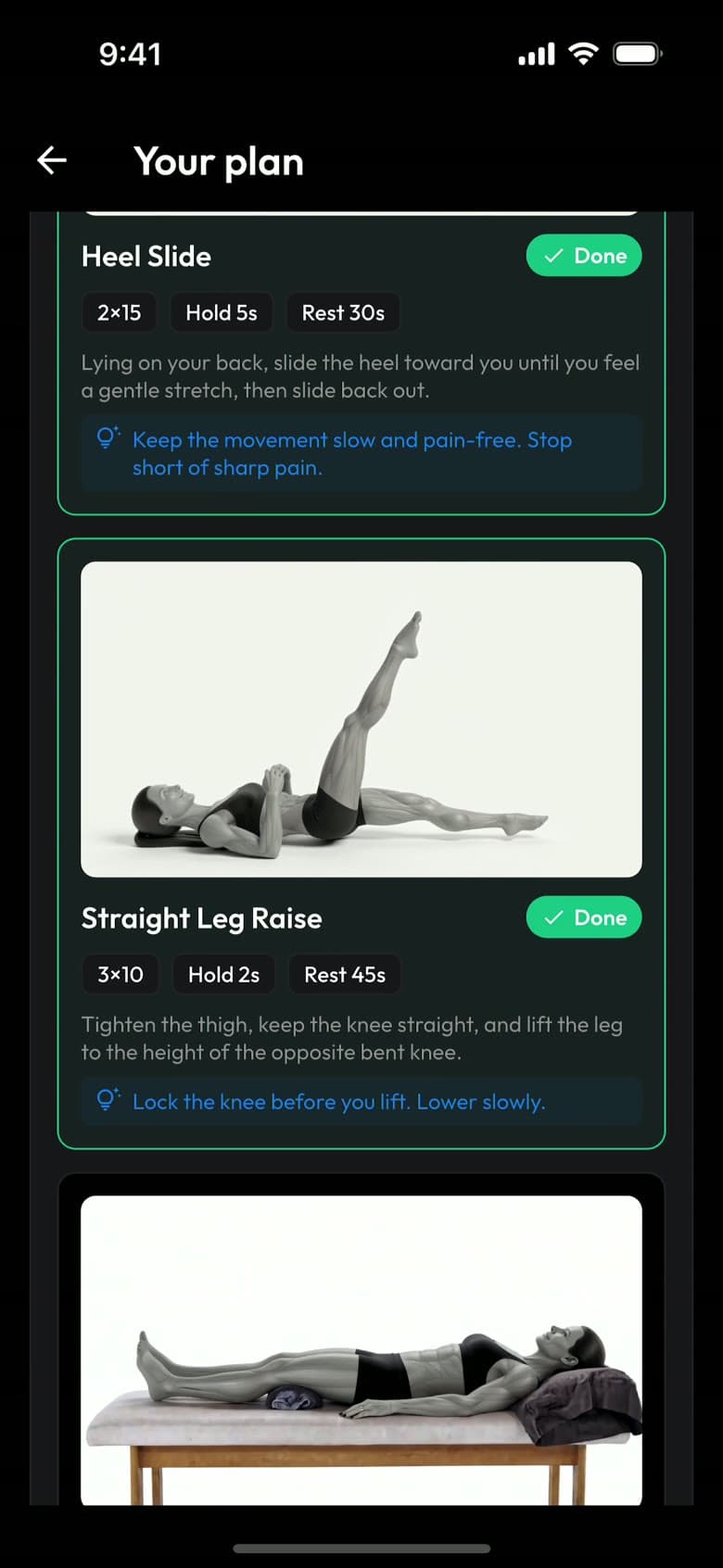
A patient does their home program with Vexa.
Every session is guided, logged, and transmitted. The patient sees a coach. The payer sees a data day.
Every day
We count the days and chase the ones who slip.
Two data days already bills. Sixteen bills the same. We watch the calendar for every enrolled patient and nudge before the month closes, so nobody sits at fourteen on the 28th.
Month end
Each patient resolves to one code.
98977 or 98985, never both. $51.44 either way. Setup billed once. Your clinicians’ review time, if they log it, is theirs on top.
By the 5th
The packet lands on your biller’s desk.
Claims-ready. Codes, day counts, consent, setup evidence, organized claim by claim. Each packet is ready the day its cycle closes; the month’s set is there by the 5th. Your biller submits under your NPI. We never touch a claim.
DATA DAYS · THIS MONTH
18 / 30
2 to 15 days → 98985 · 16 to 30 days → 98977 · same rate
CPT 98977
$51.44
device supply · 18 data days
RTM billing packet
month end · claims-ready · your NPI
delivered by the 5th
Illustrative rows. Consent, setup evidence and transmission logs attach per claim.
The 5-40-5 Guarantee
5 business days. 40 patients. The 5th of the month. Miss one and we keep working at no charge until it is met.
5business days
to go live
From signed paperwork and a named champion to a configured dashboard and a trained front desk.
40patients
enrolled and transmitting in 30 days
We only accept clinics whose caseload audit shows the patients are there. That is how we can promise it.
5th of the month
the packet lands, every month
Claims-ready, organized, on your biller’s desk. Each claim’s packet is ready the day its 30-day cycle closes; the month’s full set is there by the 5th, whatever cadence your biller runs.
Every promise is a date, a count, or a delivery. We do not guarantee what Medicare pays or when, because nobody honest can. The line we say on every call: you can stop paying us. We can’t stop working.
Who gets one
We start 4 to 6 locations a month. The audit decides who gets one.
Built for
- A private outpatient PT practice with 3 to 8 treating clinicians.
- Medicare in the mix, or commercial plans that publish RTM coverage. The audit checks which.
- Most patients go home with an exercise program. Full schedule, flat revenue, no room for a hire.
- An owner who can say yes without a board, and a biller who will sit in on one call.
Not for
- A one- or two-clinician practice. The install is sized for a caseload that clears the bar in 30 days; the software alone fits you better.
- Cash-pay only. Nothing to bill.
- A chiropractic-only practice. Medicare treats a DC as a physician only for manual manipulation.
- Anyone who wants a revenue share or a “success fee.” Our fee is flat and set in advance, always. That is not negotiable and it is the point.
- A clinic that wants us to submit the claims. We package the documentation; your biller submits under your NPI.
If it doesn’t, the audit says so, and the number is still yours to keep.
What the audit gives you
The counter gives you a number. The audit gives you the sheet your biller can argue with.
- 01
The Medicare floor, in writing.
The count and the dollars with every basis line under them, so your biller can check the arithmetic instead of trusting a widget.
- 02
Your payers, checked against published policy.
Name your top plans. Each comes back covered, prior-auth, excluded, or “no published position,” with the policy it came from and the date we verified it.
- 03
What has already gone unbilled since January.
Device-supply months do not accrue and are never paid retroactively. The sheet shows the ones behind you and the ones still in front of you this year.
- 04
A twelve-month ramp at the month-one pace.
Month one is the 40-patient bar we guarantee. The chart runs that pace out to your eligible count, billed by month, with the collections lag named.
- 05
A straight fit verdict, and the code sheet your biller will ask for.
Clears, clears with commercial, or short. If it is short, that is the answer and nobody asks you to book anything. The six codes and 2026 rates come along either way.
About two minutes. Business contact details only.
The clock
At your count, this is what 9 months of waiting already cost.
Device-supply billing that could not have been captured on 84 Medicare-eligible patients, before any covered commercial plan is counted, across the 9 full months of this year. From the counter above: 300 active, 35% Medicare.
Jan
Feb
Mar
Apr
May
Jun
Jul
Aug
Sep
Oct
Nov
Dec
3 months left this year at roughly $4,321 each. Estimate at the 2026 national rate; billed is not collected.
It is not retroactive.
Device-supply billing exists for a month only if the patient transmitted that month. A month that goes unmonitored is gone on the 1st.
Rates reset every January.
The 2026 rate is $51.44, revalued upward from 2025. CMS reprices every code every year. Nobody honest will tell you what 2027 pays.
The 2027 rule rewards clinics already built this way.
The proposed CY2027 rule would require monitoring by the billing practice’s own employees. Programs built on that structure now will not have to be rebuilt.
The audit takes two minutes. The first packet takes one month.
The pushback
What owners ask next, and what we say back.
Most of our patients aren’t Medicare. Does this still work?+
Often, yes. Medicare Advantage plans generally have to cover what traditional Medicare covers, though a plan can require prior authorization. Anthem, Blue Cross NC, Highmark, BCBS Michigan and Minnesota, and several state Medicaid programs publish RTM coverage, and UnitedHealthcare lists the codes as eligible for reimbursement. Cigna and Regence exclude it. Aetna and most other commercial plans have not published a position, which means a call to the payer, not a guess. The audit checks the payers you name against their published policy and tells you which is which.
What does it cost?+
A flat fee, set in advance, never a percentage of what you collect. The number depends on what the caseload audit shows, which is why we run the audit first and walk the price on the call, with your numbers on the table.
Who does the monitoring?+
Your clinic does. Patients train with Vexa at home; your team sees their data in the Movra dashboard. The proposed CY2027 rule would require monitoring by the billing practice’s own employees, and the program is built that way from day one. We run enrollment, engagement, and the packet; your biller submits under your NPI; we never touch a claim.
What happens if we get audited?+
Every claim your biller submits is backed by the packet Movra builds as the care happens: session-level monitoring transmissions, day counts, consent, setup evidence, organized claim by claim. You see the exact packet, blank, on the call before anything is signed. Your clinicians’ own review time, if they bill the management codes, is documented in your medical record, not ours.
Will my older patients actually use it?+
If a patient can take a video call, they can train with Vexa. We run enrollment in your clinic, the app goes on the phone before they leave, and we watch the day counts so the ones who are slipping get a nudge before the month closes. Keeping them transmitting is our job, not your front desk’s.
Do we need to connect it to our EMR?+
No. Movra runs alongside your EMR and never touches your existing systems. Your biller enters the claims from the packet like any other claim.
Anything we didn’t answer, ask on the call. If we don’t know, we say so.
Free caseload audit
Your payers, your timeline, your number. In writing.
Your active patients, your payer mix, your state. Back comes the Medicare floor with its basis, each payer checked against published RTM policy, what has gone unbilled since January, a twelve-month ramp, and a straight answer on whether you clear the 40-patient bar.
Get your free caseload auditAbout two minutes. No call required to get your sheet.
Founder-run, 4 to 6 new locations a month. The audit decides who gets one. The 5-40-5 Guarantee on every install.